Outputs Tab
The Outputs tab provides visibility into all output variables generated by the workflow. Outputs are commonly used to pass data to other workflows, automation pipelines, or external systems, making them a key integration point in Infrastructure as Code (IaC) workflows.
Outputs Table
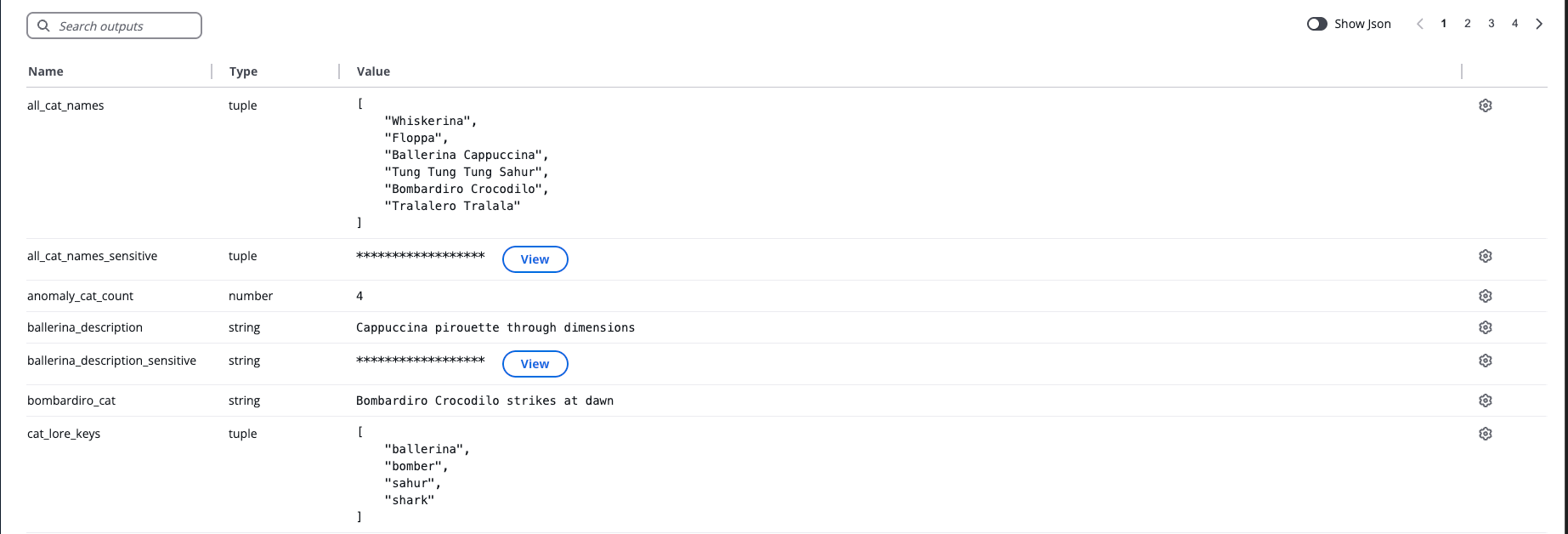
This table lists all workflow outputs.
Each output shows:
| Field | Description |
|---|---|
| Name | The output variable name defined in the workflow or Terraform configuration |
| Type | The data type (e.g. string, number, list, map) |
| Value | The actual returned value from the workflow execution |
| Options Wheel | Show the reference string, which can be used in workflows and templates |
JSON View
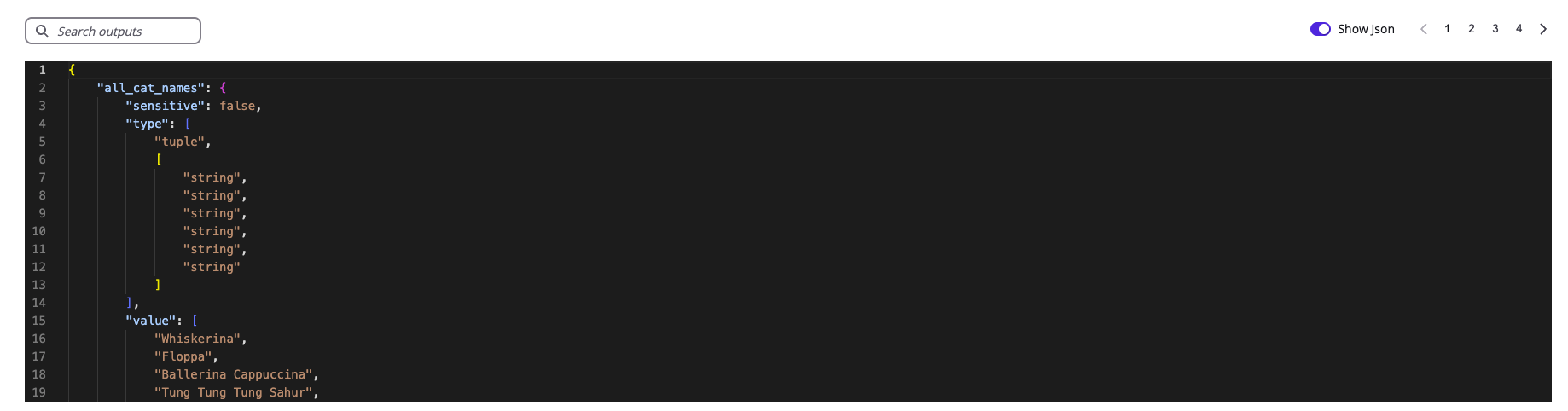
When Show JSON is enabled:
- All outputs are displayed in raw JSON format
Sensitive outputs
If the output contains sensitive fields such as credentials, passwords, or API tokens, the leaf values are marked as <sensitive> to prevent accidental exposure.
Example:
{
    "sensitive_outputs": {
        "sensitive": true,
        "type": [
            "tuple",
            [
                "number"
            ]
        ],
        "value": [
            "<sensitive>"
        ]
    }
}
When "sensitive": true, the internal leaf values are masked as <sensitive>. The masking applies to individual values within lists, maps, or other complex types, not the entire structure.
Sensitive output masking applies only to workflows executed after January 20, 2026. Outputs from workflows run before this date may still display actual sensitive values.
Output Reference
StackGuardian allows referencing of outputs between workflows. Outputs can be referenced inside VCS configuration and in Environment Variables of a workflow using the syntax below.
Terraform Workflow
- Example syntax to reference a value from the outputs generated by Terraform workflow
${workflow::<WORKFLOW_GROUP_NAME>.<WORKFLOW_NAME>.outputs.<VARIABLE_NAME>.value}
- Example syntax to a Stack which is a set of workflows that are closely associated with each other, reference a value from workflow outputs under the STACK as follows,
${workflow::<WORKFLOW_GROUP_NAME>.<STACK_NAME>.<WORKFLOW_NAME>.outputs.<VARIABLE_NAME>.value}
- Example syntax to reference an element inside an array value generated by Terraform workflow
${workflow::<WORKFLOW_GROUP_NAME>.<WORKFLOW_NAME>.outputs.<VARIABLE_NAME>.value.1}
Custom Workflow
- Example syntax to reference a value from the outputs generated by Custom workflow
${workflow::<WORKFLOW_GROUP_NAME>.<WORKFLOW_NAME>.outputs.<VARIABLE_NAME>}
Nested Workflows
To reference outputs from Workflows in a nested Workflow Groups or Stack, add the path to the Workflow Group as follows:
${workflow::<PARENT_WORKFLOW_GROUP_ID>/<WORKFLOW_GROUP_ID>.<WORKFLOW_ID>.<OUTPUT_KEY>}
For more detailed instructions on creating references, refer to the Reference Variables documentation.
Artifacts
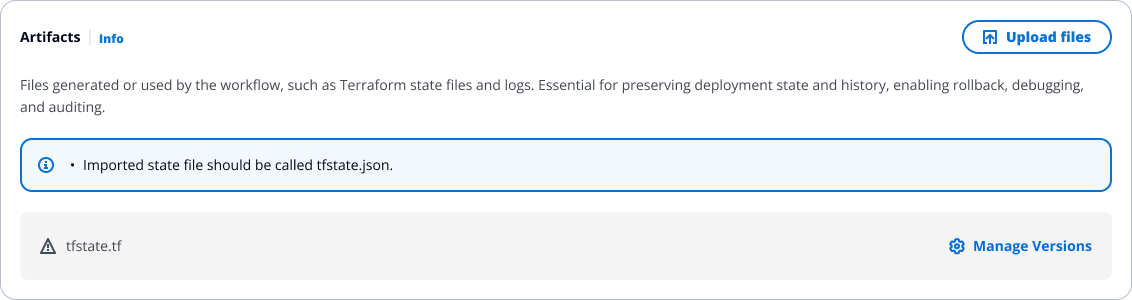
Below the Outputs table is the Artifacts section. Artifacts include files generated or used by the workflow (e.g., Terraform state files, logs).
Common artifact examples:
tfstate.json— Terraform state storage for tracking deployed infrastructure- Logs — Debugging workflow execution
- Generated files — Assets created during workflow runs
Artifacts
Actions:
- Download artifacts to inspect or reuse locally
- Upload file such as existing Terraform state to import environments (must be named
tfstate.json)
State file management
The state file is a record of the infrastructure Terraform has provisioned. StackGuardian stores and versions this file automatically, so you can track changes over time and roll back if needed.
State file management is only available for Terraform and OpenTofu Workflows configured with a managed backend.
Locking state
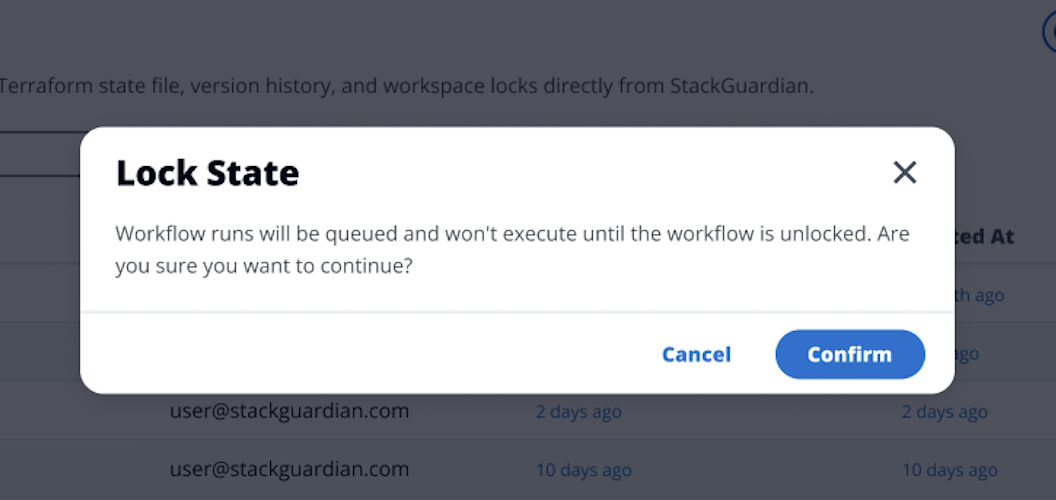
Locking prevents queued runs from executing while the state file is being modified. New runs can still be created and queued, but they will not start until the state is unlocked.
Locking is applied automatically when the Terraform CLI acquires a state lock. You can also lock the
state manually by selecting Lock State next to the tfstate.json artifact.
To lock the state:
- Select Lock State next to the
tfstate.jsonartifact. - In the confirmation dialog, select Confirm.
Locking state
When the state is locked, a warning banner appears at the top of the page:
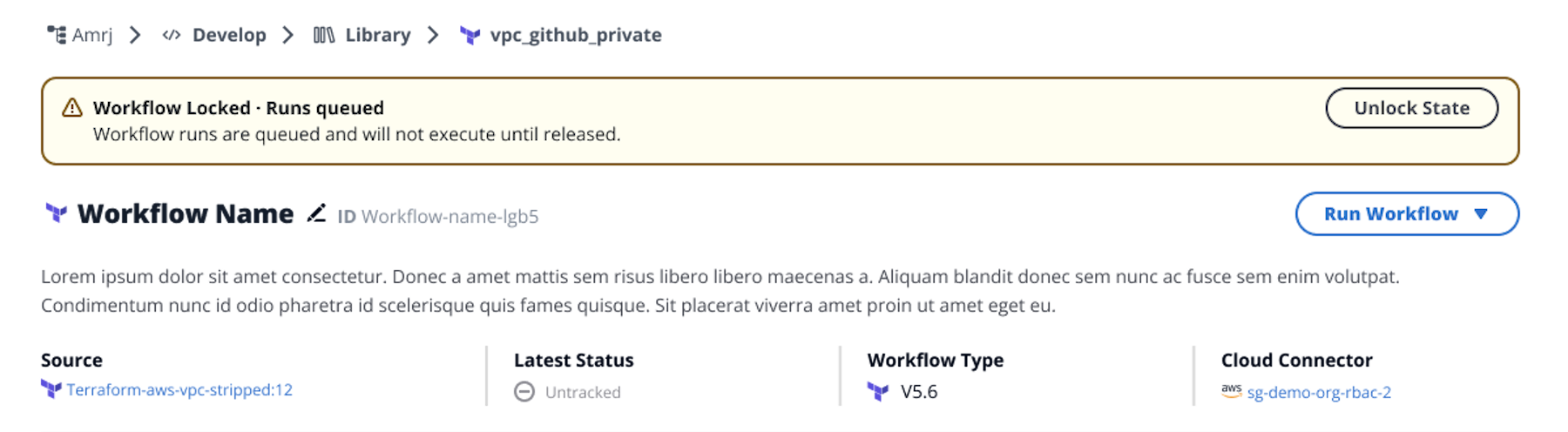
Locking warning banner
To unlock the state:
Select Unlock State in the banner.
Managing versions
Select Manage Versions next to the tfstate.json artifact to open the version history. Up to 50
versions are shown, ordered from most recent to oldest.
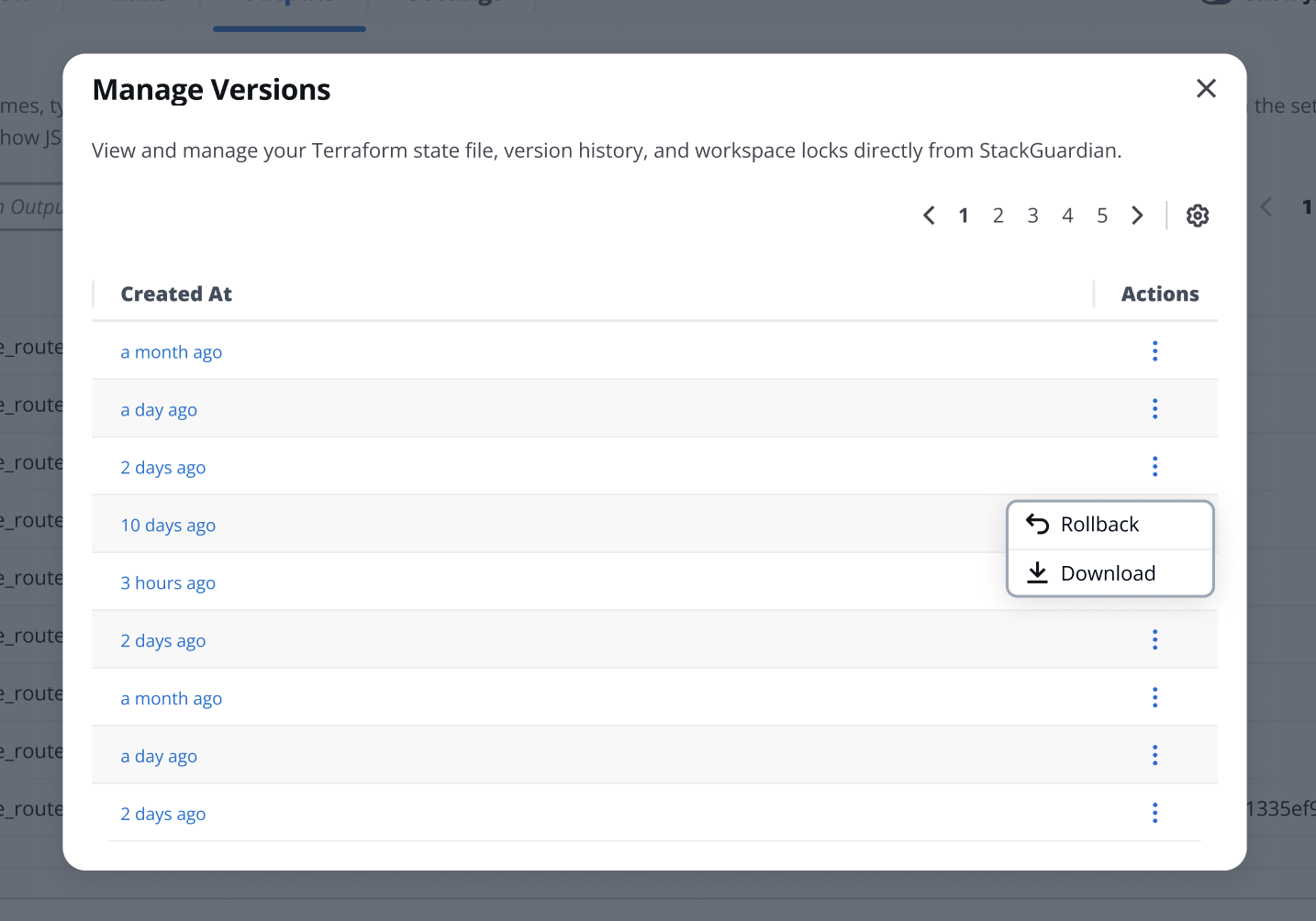
Manage versions modal
Each row includes:
- Created at — when the version was created
- Actions — available actions for that version
Select the three-dot menu in the Actions column to act on a specific version:
- Rollback — restores the Workflow to that state version. The state is locked automatically during rollback and released when the operation comple
- Download — downloads the state file for that version as a JSON file.
Rolling back overwrites the current state with the selected version. This action cannot be undone.